Description
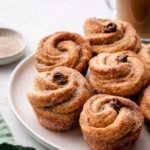
Made with buttery, flaky croissant dough and swirled with a generous cinnamon-sugar filling, these homemade cruffins bring together two classic pastries in one irresistible bake. This cruffin recipe is designed specifically for a standard muffin pan, making it easy to recreate bakery-style cruffins at home without special equipment. While professional bakeries often use deeper popover pans for taller cruffins, this approachable version delivers the same rich flavor, crisp layers, and soft center using tools every home baker already has.
Ingredients
Dough
-
1 cup (240 ml) whole milk, warmed to 110°F (43°C)
-
2¼ teaspoons (7 g) instant or active dry yeast (1 packet)
-
3 tablespoons (38 g) granulated sugar
-
3 tablespoons (43 g) butter, softened (salted or unsalted), cut into pieces
-
3 cups (375 g) all-purpose flour, spooned and leveled (plus more if needed)
-
1¼ teaspoons salt
Lamination
-
1 cup (226 g / 16 tablespoons) salted butter, slightly softened
-
1 tablespoon all-purpose flour
Cinnamon Sugar Filling
-
¾ cup (150 g) granulated sugar
-
1 tablespoon ground cinnamon
Optional Fillings
-
6 tablespoons Nutella
-
Jam
-
Lemon curd
-
Pastry cream
Instructions
📝 Preliminary Notes (Read Before You Start)
Before you begin, take a moment to review the step-by-step photos and read through the entire recipe, including the notes. This dough relies on precise timing and temperature, especially during the lamination stages.
✔️ Make sure you have enough space in your refrigerator to chill a baking sheet multiple times (steps 6–10).
✔️ Avoid extending chilling times—doing so can cause the dough to over-expand and become difficult to roll.
✔️ Work calmly and deliberately. Laminated dough rewards patience.
🥛 Prepare the Dough
In the bowl of a stand mixer fitted with a dough hook, whisk together the warm milk, yeast, and granulated sugar. Cover the bowl loosely and let the mixture sit for about 5 minutes, until a foamy layer forms on top. This indicates the yeast is active.
No stand mixer?
You can do this step in a large mixing bowl instead. In the next step, mix everything together using a wooden spoon or silicone spatula. While a hand mixer technically works, the sticky dough often clings to the beaters, making manual mixing the better option.
Add the butter, 2 cups (250 g) of flour, and the salt. Beat on medium speed for 2 minutes, stopping to scrape down the bowl as needed. Some butter pieces may remain visible at this stage—this is perfectly fine.
Add the remaining 1 cup (125 g) of flour and beat on low speed until the dough comes together and begins pulling away from the sides of the bowl. The dough should be soft and slightly tacky, but not overly sticky.
If it feels too wet, beat in up to 2 additional tablespoons of flour, but avoid adding more than necessary to prevent a dry dough.
🤲 Knead the Dough
Continue kneading the dough in the mixer for 5 full minutes, or transfer it to a lightly floured surface and knead by hand for the same amount of time.
If the dough becomes sticky while kneading, sprinkle 1 teaspoon of flour at a time onto the dough or work surface. The goal is a soft, elastic dough—not a dry one.
To test readiness:
-
Finger test: Gently poke the dough. If it slowly springs back, it’s ready.
-
Windowpane test: Stretch a small piece of dough until thin. If light passes through without tearing, the gluten is well developed.
⏳ First Rise
Lightly grease a large bowl with oil or nonstick spray. Place the dough inside, turning it to coat all sides. Cover the bowl tightly and let the dough rise in a warm environment for about 2 hours, or until nearly doubled in size.
📏 Flatten & Chill the Dough
Gently punch down the dough to release air. Transfer it to a lightly floured silicone baking mat or parchment-lined baking sheet.
Using floured hands or a rolling pin, carefully stretch the dough into a 10×14-inch (25×36 cm) rectangle, being careful not to tear it. Lightly cover and refrigerate the dough for 20 minutes only—do not extend this rest time.
🧈 Prepare for Lamination
While the dough chills, prepare the butter. It should be cool but pliable, ideally between 60–64°F (15–18°C).
Beat the butter and 1 tablespoon flour together using a hand mixer or paddle attachment until completely smooth and combined.
Before laminating, keep these tips in mind:
-
Keep extra flour nearby to dust your surface and rolling pin as needed. If butter becomes exposed, sprinkle it lightly with flour.
-
If the dough resists rolling, flip it over. If it still resists, let it rest for 5 minutes to relax the gluten.
-
Do not extend refrigeration times—this makes rolling much harder and compromises the layers.
🔁 First Lamination
Remove the dough from the refrigerator. With the long edge facing you, spread the butter evenly down the center third of the dough.
Fold one long side over the butter, then fold the opposite side over that, like folding a business letter. Pinch the short ends to seal the butter inside.
Rotate the dough so the long edge is horizontal. Lightly flour the surface and roll out to a 9×12-inch (23×30 cm) rectangle. Fold again like a business letter, cover, return to the baking sheet, and refrigerate for 20 minutes.
🔁 Second Lamination
Remove the dough from the refrigerator and rotate it so the long edge faces you. Roll out to 9×12 inches, fold like a business letter, rotate, roll again to 9×12 inches, and fold once more.
Cover and refrigerate for 20 minutes.
🔁 Third Lamination
Repeat the exact process from the second lamination: roll, fold, rotate, roll again, fold again. Cover and refrigerate for a final 20 minutes.
🌀 Shape & Fill the Cruffins
Grease a standard 12-cup muffin pan. In a small bowl, mix together the sugar and cinnamon.
Remove the chilled dough and cut it into 3 equal portions using a bench scraper or knife.
Working with one portion at a time on a lightly floured surface, roll it into an 8×12-inch rectangle. If the dough shrinks back, let it rest for 5 minutes, then continue rolling.
Sprinkle evenly with 2 tablespoons cinnamon sugar, pressing it gently into the dough. Cut into 12 one-inch strips. Stack 3 strips together, roll them into a tight spiral, tuck the ends underneath, and place into a muffin cup.
Repeat with remaining dough to make 12 cruffins total.
Cover lightly and let rise for 1 hour, until visibly puffy.
🔥 Bake
Preheat the oven to 350°F (177°C).
Bake cruffins for 25–28 minutes, until golden and the internal temperature reaches 200°F (93°C).
Let cool slightly in the pan set on a wire rack.
✨ Coat & Fill (Optional)
Once cool enough to handle, roll each cruffin in the remaining cinnamon sugar.
To fill, transfer your desired filling to a piping bag fitted with a long, narrow tip. Insert the tip about ¾ of the way down into each cruffin and gently squeeze to fill.
🏠 Storage
Store leftover cruffins covered at room temperature for up to 3 days.
Notes
Dough can be prepared and shaped the day before baking.
Store at room temperature up to 3 days.
Freeze baked cruffins up to 3 months.
- Prep Time: 4h45min
- Cook Time: 25 min
- Category: Breakfast & Brunch
- Cuisine: Bakery-Style
Nutrition
- Serving Size: 12
- Calories: 360